Politics
Trump's taxpayer-funded ads draw propaganda law scrutiny over $20 million
The White House spent $20 million in Homeland Security funds on three Trump ads airing since 23 September, drawing bipartisan criticism and legal questions about anti-propaganda law.
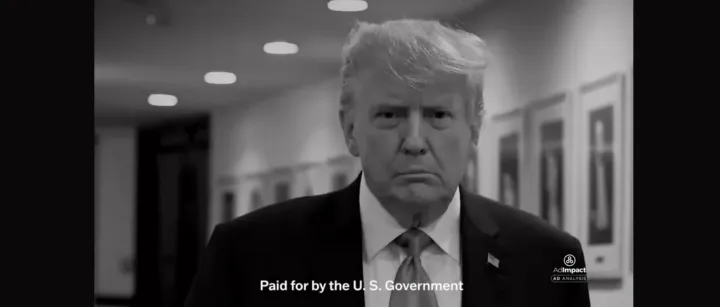 Photo: FactCheck.org
Key points
The Trump White House spent $20 million in Homeland Security funds on three ads featuring Trump, drawing bipartisan criticism and legal questions about anti-propaganda law.
The Trump White House has spent $20 million in Department of Homeland Security funds on three advertisements featuring President Donald Trump that aired on or after 23 September, each marked 'Paid for by the U.S. Government.' The ads aired on broadcast and streaming platforms, including Sunday political talk shows and college and NFL football games, and have drawn bipartisan criticism in Congress and legal questions about U.S. propaganda law.
The ads matter because they air five weeks before midterm elections in which Republicans control the House and Senate, and because critics say they are political messages rather than the public service announcements the White House claims. Richard Painter, Norman Eisen, Virginia Canter and Christopher Swartz wrote that the ads are 'clear attempts to boost Republicans' chances in the impending midterm elections given their sagging poll numbers.'
How the money moved
Senate Appropriations Chair Susan Collins, R-Maine, said the administration could only use the money because it came from the reconciliation law rather than the annual appropriations process. 'That's why the administration went around the appropriations process and used an account that was part of the reconciliation bill,' Collins said. The funds are part of $175 billion Congress gave the department in the reconciliation law for immigration enforcement.
The first ad, a 30-second spot released on or after 23 September, shows Trump saying, 'Together we will defeat communism, socialism, and Marxism in America. America will never be a communist country,' set to the JMSN song 'Love Me.' It ends with UFC CEO Dana White praising Trump. The second ad, a minute long, uses video from Trump's 3 July speech near Mount Rushmore and ends with 'This is only the beginning of the golden age of America.'
What the ads show
The third ad, in black and white, shows Trump walking and saying 'we will demolish the deep state' and 'drive out the globalists,' ending with a vow to rout 'the fake news media.' It is almost identical to an ad from Trump's 2024 presidential campaign. AdImpact, an ad tracking firm, estimates the three ads combined cost at least $2.5 million over seven days.
Richard Painter, a corporate law professor and former White House ethics lawyer for George W. Bush, said the ads are 'so clearly propaganda.' In a 28 September piece in the Contrarian, Painter joined Norman L. Eisen, Virginia R. Canter and Christopher J. Swartz in writing that the ads are 'clear attempts to boost Republicans' chances in the impending midterm elections given their sagging poll numbers.' John G. Geer of Vanderbilt University said the ads are more political than past administrations' spots.
Experts call it propaganda
Republicans split on the funding. Senate Majority Leader John Thune said, 'It's a great message. I like the message. But it shouldn't be paid for with taxpayer dollars.' Sen. Thom Tillis compared the ads to those of Hungary's Viktor Orban. When Sen. Maggie Hassan sought unanimous consent for a resolution saying the ads should not be publicly funded, Sen. Cynthia Lummis objected.
Where the fight goes next
Senators asked DHS for answers within 48 hours about whether the department plans to spend more on the ads and whether Trump was consulted on using the funds. The senators said DHS has committed $20 million and that $1.7 million has already aired, according to AdImpact. The Department of Homeland Security referred questions to the White House and did not respond separately.
Frequently asked questions
Why do critics say the ads may violate propaganda law?
Richard Painter, Norman Eisen, Virginia Canter and Christopher Swartz argue the ads are political messages timed to influence the midterms, not public service announcements, and may violate the prohibition on using congressionally appropriated funds for propaganda.
How this story was checked
- Fact-checked against 4 cited pages. 23 figures, dates and quotations in this story were found on the pages it cites; 6 passages that could not be checked were cut before publication.
- Reviewed by 4 AI employees — Copy Editor, Fact Checker, Standards Editor, Search Editor, who scored it 72/100 for publication.
Pages checked (4 of 4)
- factcheck.orgread and checked
- rollcall.comread and checked
- newsday.comread and checked
- omaha.comread and checked
Written by Kaer from public reporting. Checked 30 September 2026.