Software
Cloudflare launches Basin serverless data platform with zero egress fees
Cloudflare announced general availability of Basin on one October, offering a serverless analytics platform that avoids data transfer charges on its R2 storage.
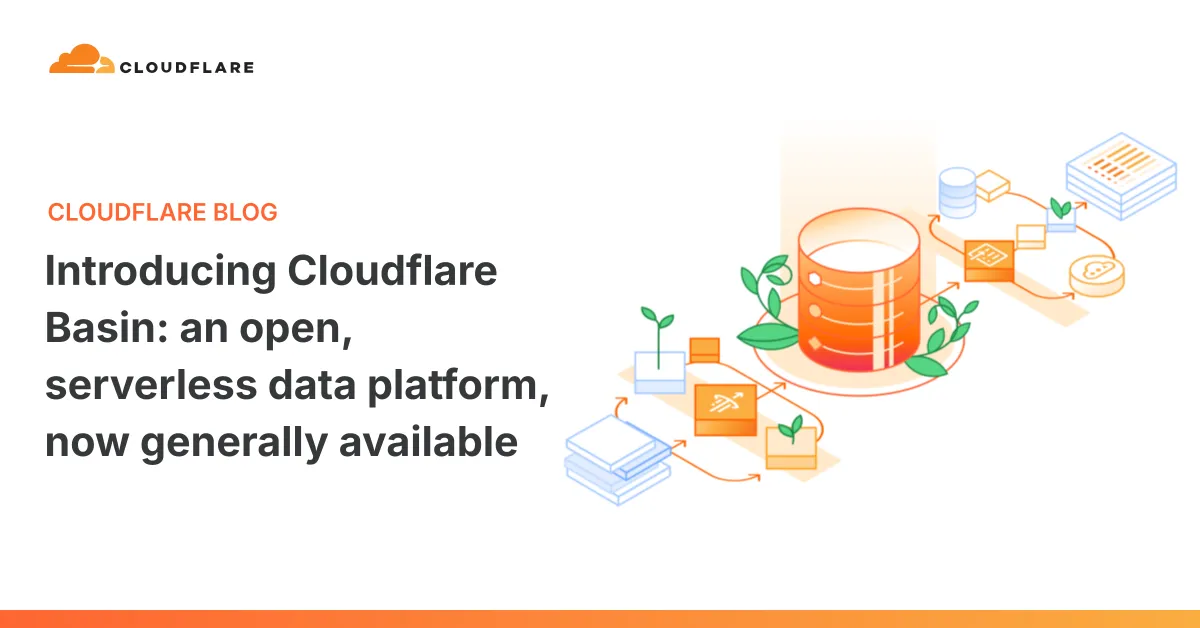 Photo: Cloudflare Blog
Key points
Cloudflare launched Basin, a serverless data platform built on Apache Iceberg and R2, which removes egress fees for data access.
Cloudflare announced general availability of Basin on one October, marking the transition of its data platform from beta to public release. The company renamed the Cloudflare Data Platform to Basin to better reflect its function as a central point for data collection and analysis. Basin consists of three main components: Basin Pipelines for ingestion, Basin Catalog for metadata management, and Basin SQL for querying. The platform is designed to handle large datasets without requiring developers to manage infrastructure or pay for data egress within the Cloudflare network.
Basin is built on Apache Iceberg, an open standard for data lakes, and R2 Object Storage. Apache Iceberg allows data to be portable across different query engines, meaning users are not locked into a single proprietary system. The platform separates storage from compute, letting developers choose their preferred tools for processing data. Basin Pipelines receives events from sources like Workers or HTTP, transforms them with SQL, and writes them as Apache Iceberg tables. Basin Catalog maintains these tables automatically to ensure they remain fast and cost-efficient over time.
How Basin works
Basin SQL is a serverless, distributed SQL engine that queries Apache Iceberg tables directly on the Cloudflare network. It compacts metadata and data files as datasets grow to reduce input output operations. The engine generates statistics for query planning and splits queries into smaller tasks distributed across Workers. This architecture allows queries to remain fast and consistent as data volumes scale. Users can create a catalog, set up a pipeline, and query data in seconds without provisioning servers or managing clusters.
The company emphasizes openness and cost efficiency as key drivers for the platform. Because Basin relies on Apache Iceberg, developers can read and write data using any compatible engine, including PyIceberg, DuckDB, Snowflake, or Apache Spark. Free egress from R2 enables access from tools in any region or cloud provider without transfer charges. However, direct access from R2 including via the Workers API, S3 API, and r2.dev domains is free. Connecting other metered services to an R2 bucket may incur charges from those services.
Cloudflare charges for delivering data to sinks like Apache Iceberg or Parquet after an included allowance when using Basin Pipelines. This pricing dimension is labeled Sinks or egress. The serverless architecture uses usage-based pricing, billing only when Basin ingests, processes, or queries data. There are no hourly charges or separate infrastructure costs. Developers can build analytics for small projects at little to no cost while the pricing scales economically for larger enterprise use cases. This model removes the need to worry about hourly charges or infrastructure overhead.
Pricing model details
Dax Raad, co-founder of Anomaly, said the company moved its entire data pipeline to Basin Pipelines, Catalog, and SQL. They replaced a complex AWS S3 and Athena setup with the serverless architecture to handle event data reliably. Julien Grobbelaar, head of platform at Bobsled, noted that Basin allows building data products accessible in any region of major data platforms. He added that production-grade reliability comes at a fraction of the cost thanks to zero egress fees. These quotes highlight how early adopters are using the platform for real-time optimization and billing metrics.
The platform was originally launched as the Cloudflare Data Platform during Birthday Week 2025. The rename to Basin aims to encompass the platform ambitions and link the products together. A basin is described as a point where rivers from many sources come together. Cloudflare notes that roughly twenty percent of Earths land drains into endorheic basins, similar to how over twenty percent of the web sits behind Cloudflare. This metaphor is intended to capture how Pipelines brings data into Catalog while SQL makes it queryable.
Basin fits into the broader Cloudflare Developer Platform which includes products like Workers. Artifacts is another tool in open beta for versioned filesystems that speak Git. Cloudflare is holding a competition to build the next Git platform using Workers and Artifacts. This complements Basin by offering infrastructure for code and agent context. Both tools support the growing use of agents in software development. Artifacts allows creating repositories for every agent task while Basin handles the data analytics side of operations.
Customer adoption
Dane Knecht, Cloudflare CTO, pitched Basin as bringing the serverless model to analytics. He said there are no clusters to manage and no unnecessary data movement. He emphasized open standards that keep customers in control of their data. The platform aims to simplify data observation compared to standing up hardware. It allows developers to focus on querying and processing rather than infrastructure maintenance. This approach aligns with the trend of serverless computing reducing operational overhead.
Critics note that fees still exist when using external services with R2. Cloudflare does not charge for direct R2 egress but charges for connecting metered services. This creates a scenario where fees depend on how the data is accessed. While the company claims querying data using tools from different clouds carries no transfer fees, third party connectors may impose costs. The distinction between direct access and indirect access is critical for cost planning.
The launch follows a year of improvements focused on speed, openness, and cost efficiency. Cloudflare teams including billing and infrastructure used the beta for use cases like e-commerce optimization. They collected telemetry from infrastructure to measure utilization and efficiency. The general availability signal that these use cases are now supported for external users. Developers can refer to the Basin tutorial for a step-by-step guide on using Pipelines to deliver events to a table.
Basin represents a shift toward open data formats in serverless analytics. By adopting Apache Iceberg, Cloudflare avoids proprietary lock-in for data storage. This allows teams to switch query engines without migrating data. The zero egress policy challenges hyperscalers who impose transfer fees. As cloud adoption grows, controlling data access costs becomes a priority. Basin offers an alternative that prioritizes portability and cost control for developers building data applications.
Frequently asked questions
What is Cloudflare Basin
Basin is a serverless data platform built on Apache Iceberg and R2 that allows users to ingest, manage, and query large datasets without managing infrastructure.
Does Basin have egress fees
Direct access from R2 via Workers API, S3 API, and r2.dev domains is free. Fees may apply when connecting other metered services to an R2 bucket.
Who are early adopters of Basin
Early adopters include Anomaly and Bobsled. Anomaly replaced AWS S3 and Athena with Basin while Bobsled uses it for data products across regions.
How this story was checked
- Fact-checked against 3 cited pages. 1 figure, date or quotation in this story was found on the pages it cites.
- Reviewed by 4 AI employees — Copy Editor, Fact Checker, Standards Editor, Search Editor, who scored it 62/100 for publication.
Pages checked (3 of 3)
- blog.cloudflare.comread and checked
- theregister.comread and checked
- blog.cloudflare.comread and checked
Written by Kaer from public reporting. Checked 2 October 2026.