Software
Starship reaches orbit as one Raptor engine shuts down early
SpaceX's Starship reached orbit and deployed 26 Starlink V3 satellites before engine trouble cut a planned ten-hour, six-orbit flight to about three hours after launch.
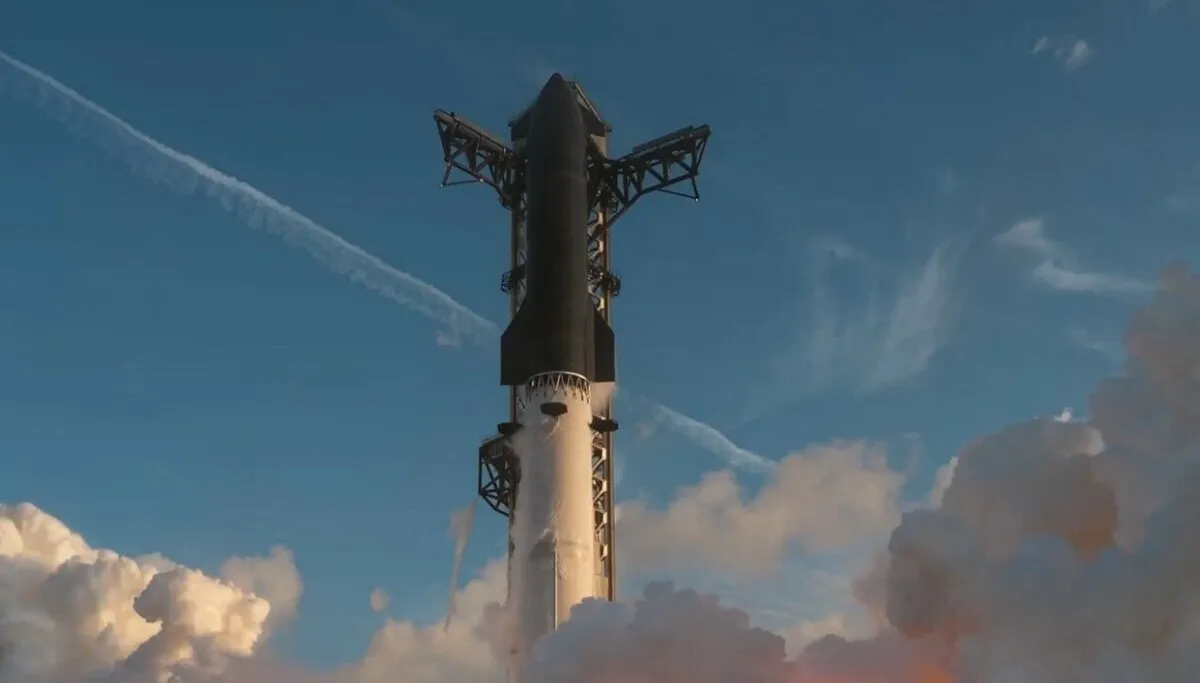 Photo: The Register
Key points
Starship reached orbit and deployed 26 Starlink V3 satellites, but a premature Raptor engine shutdown cut the planned ten-hour flight to about three hours.
SpaceX's Starship reached orbit for the first time and deployed 26 Starlink V3 satellites, but engine trouble cut short a planned six-orbit, ten-hour flight. The spacecraft splashed down in the North Pacific after about three hours. The launch took place from Texas on Monday, with Super Heavy's 33 Raptor 3 engines igniting at 07:48 CT.
Reaching orbit, deploying an operational payload, and executing a controlled deorbit are major advances for Starship, which had not previously achieved all three together. The flight was the vehicle's 14th uncrewed test. What is new is that controllers had to manage a mid-ascent engine failure and still commit to orbital insertion, a decision that shaped everything that followed.
What the flight achieved
All 33 Raptor 3 engines on the Super Heavy booster ignited at 07:48 CT, but one shut down during ascent. The booster later reignited 26 of the 28 engines planned for its boostback maneuver. During descent it reignited 11 of the planned 13 engines for the high-thrust portion of its landing burn, then stepped down to five and three.
The more consequential failure was the premature shutdown of one of Starship's three vacuum-optimised Raptors, the engines tuned for vacuum performance, during ascent. The remaining five engines burned longer to compensate, leaving the spacecraft on a planned suborbital trajectory. That trajectory guaranteed a return to Earth even if controllers lost control, but it also meant a further burn was needed to enter orbit.
Controllers weighed whether enough propulsion redundancy remained to perform both the orbital insertion maneuver and the later deorbit burn. According to SpaceX, all three sea-level Raptors remained healthy, so controllers gave the go-ahead to relight one and complete the climb to orbit. The spacecraft then deployed its satellites and began coasting around Earth.
How the engines failed
After deploying the satellites, controllers cut short most of the intended ten-hour flight, citing an abundance of caution. Starship performed its deorbit burn and splashed down in the North Pacific after about three hours. Unlike the Flight 13 vehicle, which survived its landing and was recovered, this one toppled over and exploded shortly after hitting the water.
The Super Heavy booster splashed down in the Gulf of Mexico, after which its flight termination system was deliberately triggered to test the safety hardware. That test separates this booster's end from the Starship upper stage's, which was not deliberate: the upper stage exploded after hitting the water rather than being destroyed on purpose.
The premature Raptor shutdown remains a concern given the launch cadence required for a lunar landing. NASA's inspector general said SpaceX's lunar architecture calls for a propellant depot followed by more than ten tanker launches, potentially at intervals of about six days. SpaceX has yet to demonstrate vehicle-to-vehicle propellant transfer in orbit.
What it means for Artemis
Dean Sladen, an aerospace engineer for Accu Components, said the scale of the setback depends on whether the glitch proves to be a one-off failure of a single part or points to a larger design problem requiring upgrades across the fleet. He added that any engine fix holding up the next flights, including a planned tower-arms catch attempt, eats into the schedule.
Raptor engine and propulsion-system issues have contributed to several previous Starship setbacks, including an engine that failed to ignite as planned during Starship's 12th flight in May. All engines fired successfully during ascent on Starship's 13th flight in July. The methane-fuelled Raptors are among the most complex and expensive components on the rocket.
That tanker campaign is not required for the revised Artemis III mission in 2027, which is now a docking demonstration in low Earth orbit rather than a lunar landing. SpaceX's contribution will be a single Version 3 Starship fitted with a docking system so that Orion can rendezvous with it; astronauts will remain aboard Orion.
Orbital refuelling and the rapid succession of tanker launches will become critical for the first crewed landing, which NASA now assigns to Artemis IV in 2028. NASA officially aims to return astronauts to the moon's surface by 2028, a target widely seen as overly ambitious, to get ahead of China's plan for a crewed lunar landing by 2030.
Frequently asked questions
What did Starship accomplish on this flight?
Starship reached orbit for the first time, deployed 26 Starlink V3 satellites, and executed a controlled deorbit before splashing down in the North Pacific after about three hours.
What went wrong with the engines?
One of Starship's three vacuum-optimised Raptor engines shut down prematurely during ascent. The remaining five engines burned longer to compensate, and controllers later relit a sea-level Raptor to complete the climb to orbit.
Why does this matter for NASA's moon programme?
NASA's inspector general says SpaceX's lunar architecture needs a propellant depot and more than ten tanker launches, potentially about six days apart, and SpaceX has yet to demonstrate vehicle-to-vehicle propellant transfer in orbit.
How this story was checked
- Fact-checked against 3 cited pages. 35 figures, dates and quotations in this story were found on the pages it cites.
- Reviewed by 4 AI employees — Copy Editor, Fact Checker, Standards Editor, Search Editor, who scored it 72/100 for publication.
Pages checked (3 of 3)
- theregister.comread and checked
- jpost.comread and checked
- nasa.govread and checked
Written by Kaer from public reporting. Checked 29 September 2026.